What if & Research Aircraft

Return to Index

The builds on this page are all grounded in reality in some way or other.

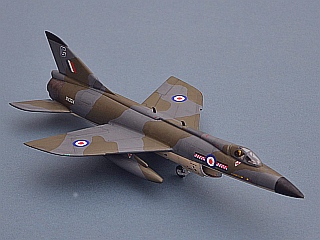
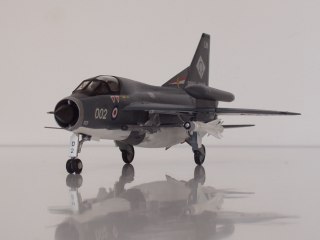
BAC Sea Lightning: Full Build Article

Sea Lightning

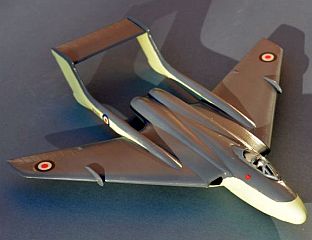
Saunders Roe(SARO)/Armstrong Whitworth P177N (Freightdog Models)

http://en.wikipedia.org/wiki/Saunders-Roe_SR.177

Link to Build Page

What a fantastic model - fits all my favourite criteria, RN, Cold War, exotic, serious technology, excellent detail and easy to build. Although I have used resin parts many times before, this was my first full resin kit and it went together surprisingly easily, with no filler other than a bit of extra superglue here and there.

Built entirely out of the box, using the superb included transfers for a "what if" rocket and jet powered interceptor aircraft, cancelled as a result of the infamous 1957 Duncan Sandys Defence Review, that could have served with 803 Sqn in the 1970s, based onboard the planned CVA01, HMS QUEEN ELIZABETH.

The SR177 was real, RAF & Foreign customers wanted it, and the manufacturing jigs were in place and ready to go, when the project was cancelled.

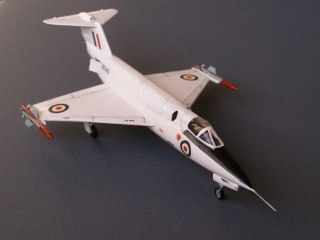
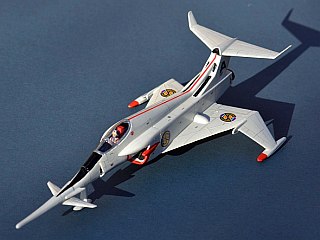
Saunders Roe SR53 (Airfix)

Isle of Wight based Saunders Roe produced the elegant and successful SR53 research aircraft to prove the concept of a dual rocket/jet powered interceptor. Two prototypes were produced; one suffered a fatal crash, thought to be the result of the instrument panel breaking loose on take-off, but the other continued to provide valuable data for the SR177 production project. http://www.spaceuk.org/sr53/sr53_1.htm
Link to Build Page

SR53

SR.53 at RAF Museum Cosford

Cosford's SR.53

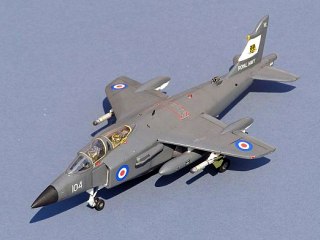
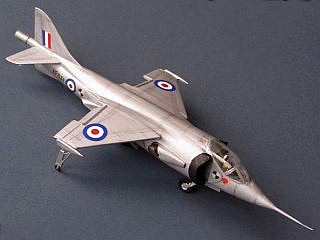
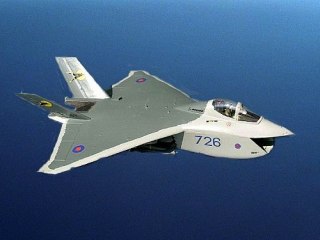
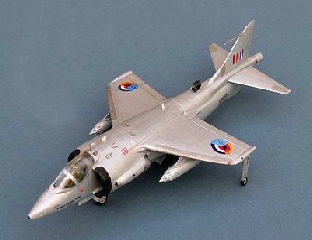
Hawker P.1154 RN Osprey/Sea Harrier. 804 Sqn Fleet Air Arm, HMS HERMES, 1978 (What-if?).

Project X Vacform, with scratch additions and decals from various sources. Link to Build Page

The P.1154 was Hawker's original proposal for an in-service VSTOL aircraft developed from the P.1127. With the powerful BS.100 engine it would have been supersonic, whilst a full size AI radar and BVR missiles would have given it a weapons capability similar to the Phantom. Predictably, it was not to be; trying to build a ground attack aircraft for the RAF and a Fleet fighter for the RN using the same airframe was always an unrealistic target. In addition, the Plenum Chamber Burning ( a sort of vectored afterburner) which was needed for supersonic flight never really worked and in any event, it produced extreme exhaust temperatures that would have buckled any ship's deck.

P.1154 RN

Although the RAF's single seater P.1154 was officially named Harrier before its cancellation, the P.11154 RN was cancelled before it was named. Osprey was certainly one possible option, although it might simply have been the Sea Harrier. Instead, a basic "operationalised" version of the P.1127 became the GR.1 RAF Harrier that we all know, while the RN received the excellent F-4K Phantom instead (which it had wanted all-along).

P.1154 RN

But, What-if?..........

Link to In-Service P.1154RN pictures:

P.1154 - 767 Sqn


Lockheed Martin F-35 Lightning 2 Joint Strike Fighter (Revell)

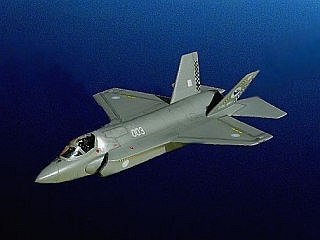
The planned replacement for the Sea Harrier and GR9. Based on the Revell X-35 kit, with surplus Sea Harrier markings for an 801 Naval Air Squadron Aircraft, bearing the tail code W for HMS PRINCE OF WALES (the RN's 2 new carriers will be HM Ships QUEEN ELIZABETH and PRINCE OF WALES).

... and the real thing:

F-35 Lightning II - 801 Sqn Fleet Air Arm

Boeing F-32 Joint Strike Fighter (Italeri)

The losing contender in the JSF contest. Weird looking isn't it! Italeri kit with surplus Sea Vixen and other markings.

Boeing X-32 as an F-32 892 NAS

Boeing X-32 as an F-32 892 NAS

Boeing X-32 as an F-32 892 NAS

.... and the real thing in the air:

BoeingF-32 892 Sqn Fleet Air Arm

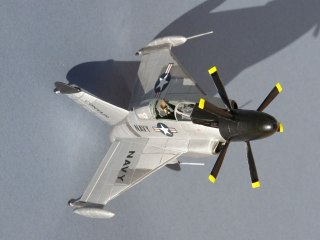
Convair XFY-1 Pogo VTOL Fighter, US Navy 1957 (Kopro)

The Pogo was part of a USN programme to develop a VTOL fighter for use on small "carriers" and merchant ships (a bit like the Royal Navy's Hurricane Catafighters). Although it flew successfully, it was never a practical prospect and the concept was eventually binned as more capable conventional jet fighters rendered it obsolete. Photographs of the Pogo in flight usually show the canopy open; a reflection of the pilot's low confidence in the aircraft and its early ejection seat system. Only one pilot flew it untethered successfully; take off and steady flight were reasonable, but accurate and safe landing was particularly difficult. Operation afloat on the intended merchant ships and small carriers in high sea states would undoubtedly have been a challenge !

Pogo 1

Pogo2

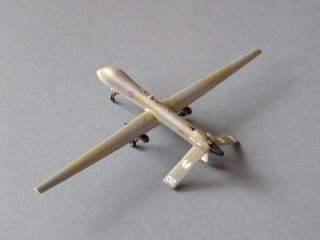
General Atomics MQ-1 Predator, 2008 - Italeri, with own speculative decals - 809 Naval UAV Sqn, RNAS Donibristle, 2012 (!).

Those of you who take your modelling seriously may feel that I have lost the plot completely on this one, but it is not as fanciful as it may seem. Granted, the RN does not operate Predator UAVs, nor is it likely ever to do so (although the Maritime variant of the larger Reaper UAV is not beyond the bounds of possibility). Even if they did, the UAVs would probably be pooled with the RAF and Army (Joint Force UAV?), and certainly wouldn't be painted in the Fleet Air Arm's WW2 Temperate sea scheme of Sewage and Slime (Dark Slate Grey and Extra Dark Sea Grey topsides, with Sky undersides). But the kit supplied scheme is just so....well......grey!.

.............and if the Italians can camouflage their Reapers, why couldn't we?

Predator A

The Predator A and its much larger cousin, the Predator B or "Reaper" represent a new generation in military aviation. Flown under local C-Band Line of Sight control for take-off and landing, once in the air, the aircraft are flown using Ku-Band satellite links for control. In this way, Reapers and Predators are currently flown over Iraq and Afghanistan by US and RAF pilots from a remote corner of the Nevada desert. Italy operates its own Predator aircraft, whilst RAF pilots from 39 Sqn/1115 Flight fly US aircraft and have recently acquired a number of their own Reapers. Originally unarmed, both versions now regularly carry and use Hellfire missiles.

Predator A

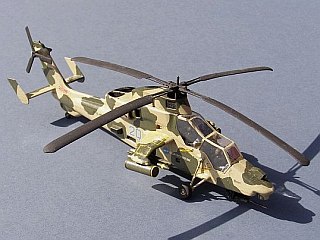
BAe/Eurocopter Tiger AH1

Just what the Royal Marines needed. I seem to have a penchant for backing the wrong horse in procurement competitions. The Apache has a much greater weapon carrying capability than the Tigre, so this one lost out. This is the rather basic Italeri kit, marked up with RM markings.

Tiger AH.1

Tiger AH.1

Tiger AH.1

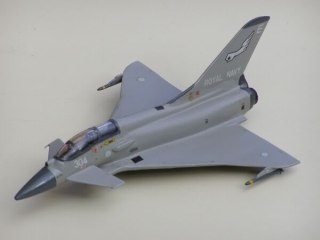
Carrier Eurofighter

OK, it's really the Pegasus EAP. Not an easy kit to build. Hooked Eurofighters really were one of the fallback options for CVF if JSF wasn't available. It was never really a practical proposition; the aircraft is very tail heavy, which is not ideal for carrier ops. Rafale would have been a better option, or Super Hornets if we were willing to compromise on capability.

Hawker P1127 Kestrel (Airfix)

The Airfix P1127 was the first ever kit I built, back in the 1960s, and the start of a long lasting enthusiasm for the Harrier; of course, this one was built more recently than that, with far better decals than I remember (which represent the aircraft at the time of its famous trials on HMS ARK ROYAL). Airfix's P1127/Kestrel is crude, ill fitting and inaccurate.....Ahhh, but the memories!

Hawker P.1127

Hawker P.1127

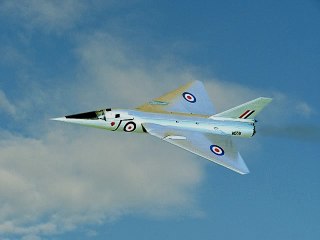
Fairey Delta II (World Air Speed Record Holder) (Frog)

Frog's Delta is a simple, but surprisingly accurate kit of this iconic British aircraft.

Flown by (ex Fleet Air Arm Lt Cdr) Peter Twiss, on 10 Mar 1956 The Fairey Delta 2 achieved a new World Air Speed Record (1,132mph). Although it was a direct influence on Dassault's subsequent design for the superb Mirage fighter, bold Fairey plans to develop the concept for British service (e.g. the F155T) were yet another victim of the Duncan Sandys' Defence Review.

Fairey Delta 2 (Frog)

This aircraft, WG774 (the other was WG777) was later absorbed into the Concorde programme and rebuilt as the BAC221 to trial the configuraton of Concorde's ogive-ogee curved wings. Both FD2s survive - WG777 at Cosford and WG774 at Yeovilton.

BAC 221 at FAA Museum Yeovilton

Yeovilton BAC221 (ex FD2 WG774)

Fairey Delta 2 at RAF Museum Cosford

Cosford FD2 (WG777)

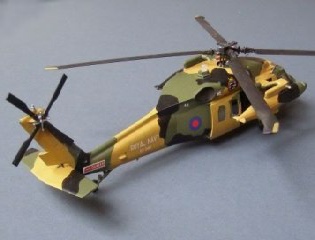
Westland Sikorsky WS-70 Black Hawk - 845 NAS, Helmand , 2012 (What-if?).

Hasegawa with speculative markings & serial.

In the late 1980s, Westland Helicopters were struggling to stay in business. Having worked with Sikorsky in the past (the Dragonfly, Whirlwind, Wessex, & Sea King were all based on Sikorsky designs) they began to forge even closer links with the US firm and its owner United Technologies. As part of this arrangement, Westland gained the European manufacturing rights to the S-70 Black Hawk design and set about marketing it to European nations as a replacement for the Wessex/Puma class of medium support helicopters.

However, Westland's efforts met with strong opposition - the Gulf War proved that larger helicopters (in the Chinook class) were required and the RAF was adamant that it did not want the Black Hawk under any circumstances (although it was later forced to adopt the Merlin HC.3 instead). The political arguments around Westland's ownership led to a bitter split inthe UK Conservative government, with the furious resignation of Michael Heseltine, the UK's Trade and Industry Minister, who had championed the retention of an independent UK and European aircraft industry, against the free market doctrine of Prime Minister Margaret Thatcher, and the beginning of the revolt that would lead to Thatcher's perumptory removal from power in 1991. In the end, the WS-70 could not be sold in the competitive and nationalistic European market, and was quietly dropped from the Westland catalogue when the company transferred back to European ownership.

But events could have taken a different turn..................................

Black Hawk

Black Hawk

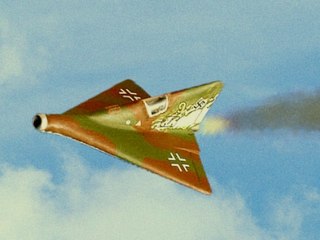
Horten Ho-229/Gotha Go228 V7 Nachtjager - Reichs Antarktika Luft Korp, 1947 (What-if?).

PM out the box. A very simple, kit, but an easy and enjoyable build. Link to Build Article

This kit represents the V7 radar equipped night fighter design that was never built, although PM and Revell also do a kit of the single seat day fighter/bomber.

The Horten Brothers were highly regarded designers of gliders in the 1930s, who specialised in low drag flying wing designs. In 1943 they presented several radical flying wing designs for jet powered long range Luftwaffe bombers. One of these designs, the Horten IX, was accepted by the Reichs Luft ministry (RLM) and passed to the Gotha company for development and manufacture. Initial prototype flight testing of the Ho-229 (some sources describe it as the Go-229) was hugely successful, but due to the exigencies of the war, the bomber design was quickly adapted to become a fighter, taking full advantage of its low drag and high speed, plus the considerable fuel volume that could be accomodated in the large wing structure (a must ofr the first generation jet engines). An extra bonus came from its carbon impregnated plywood construction, which minimised the use of strategic materials and, through pure luck combined with its stealthy layout, made the aircraft very difficult to detect by radar.

It remains doubtful that it would have been a success in the fighter role, as a basic limitation of the flying wing layout is a lack of lateral stability - dogfighting could have been extremely difficult. Nevertheless, it was a remarkably advanced design, not least in its use of complex aerofoil sections, which, under different circumstances could have become an important part of the Luftwaffe's inventory.

The Horten flight prototypes and designs were captured by advancing US troops in 1945 before they could be put into volume production - all bar one prototype was destroyed, with the sole single seat fighter survivor being passed on to the Northrop company in the US for evaluation (Northrop had worked with Horten before the war and were familiar with their designs). Horten's principles were adapted into a number of their own flying wing designs, with a strong family resemblance to the original Horten IX still evident today in the USAF's latest B-2 Stealth Bomber.

Horten Ho-229

Horten Ho-229

Horten Ho-229

Horten Ho-229

Horten Ho-229

Of course, a proper WHIF build needs to have an imaginative back story to place it in context - so here is my version of the Horten Ho-229 Nachtjager's operational career: The Defenders of Antarktika

And here are a few good links for information and pictures of the real thing!

http://jpcolliat.free.fr/ho9/ho9-1.htm (sorry - its in French, but seems to be the best website on the Horten)

IPMS Stockholm - Ho229 Article

warbirdsresourcegroup - Ho229 Details & pictures


Return to RN Jets index

Return to Fred's Builds Main Index


Return to Index

www.gengriz.co.uk