August 2010 Hawker Hurricane and Supermarine Spitfire
Links
to related pages on this Website: 

 This
Month's significant WW2 70th Anniversaries:
This
Month's significant WW2 70th Anniversaries:
The Battle of Britain
1-11
Aug - Kanalkampf - Luftwaffe and RAF aircraft battle over the Channel
4
Aug - US Army General Pershing, in a nationwide radio broadcast,
urges the United States to provide all-out assistance to Great
Britain, in the vital interest of the United States. Aviation hero
Charles Lindberg urges the opposite, prefering isolationism and tacit
Nazi support.
12
Aug - Luftwaffe Erprobungsgruppe 210 begin attacks on RAF Radar
Stations, attempting unsuccessfully to blind the British air Defence network.
13
Aug - Adlertag - The Luftwaffe begin their main assault on the
United Kingdom.
15
Aug - Luftwaffe sorties against the UK reach a peak.
18
Aug - Both sides suffer their largest casualties in a single day.
Ju87s and Bf110s are withdrawn from the campaign as they have proved
too vulnerable to RAF fighters. Goering orders fighters to escort the
bombers more closely.
19
Aug - Luftwaffe efforts concentrated on British aircraft factories
20
Aug - Luftwaffe efforts turn to British Fighter Airfields. Winston
Churchill pays tribute to the pilots of the RAF: "Never
in the field of human conflict was so much owed by so many to so few"
23
Aug - First bombing raids on London. From 25 Aug, the RAF begins
raids on Berlin in retaliation
Although
aircraft can be replaced, RAF pilot loses are unsustainable. 58
Fleet Air Arm pilots and a number of RAF single engine bomber crews
are transferred to Fighter Command. Polish and Czech Squadrons become
fully operational as their existing high level of expertise becomes
more fully appreciated.
26
Aug - In perhaps the first sign that the tide has turned, Chad
becomes the first French Colony to side officially with the Allies
and Free French.
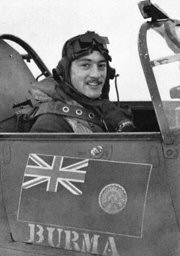
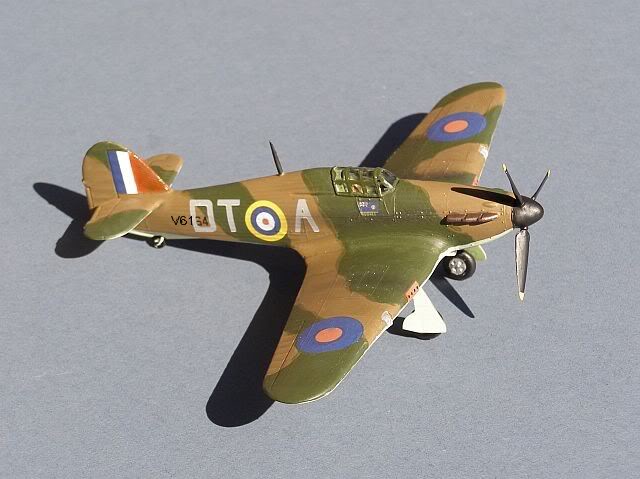
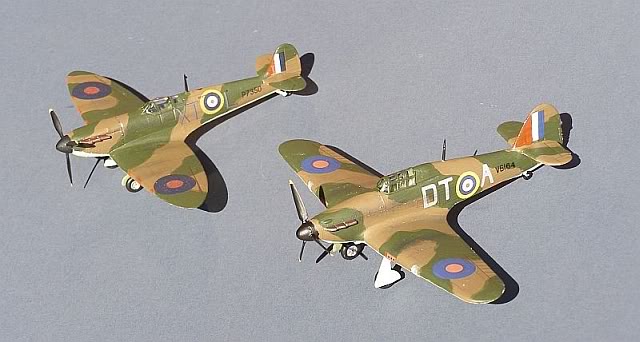
Hawker Hurricane Mk.1 - 257 (Burma) Squadron,
RAF Coltishall, Battle of Britain, September 1940
Airfix 1/72 - "Thay myay gyee shin shwe hti" (Burmese: "Death or glory")
|
|
The Hurricanes of RAF Fighter Command bore the brunt of the RAF effort during the Battle of Britain. Whilst the Spitfires engaged with the high performance German fighters, the Hurricanes attacked the primary target: the bombers. A typically robust product of Hawker's engineering excellence, the Hurricane was a balanced and effective evolutionary design compared with the Spitfire's revolutionary innovation. 257 Sqn was based at RAF Coltishall, and led by Sqn Ldr Bob Stanford-Tuck DSO, DFC (2 Bars), AFC. Tuck was an amazing man, who fought with great distinction during the Battle of France and Battle of Britain. In 1942, flying a Typhoon on fighter sweep across occupied Europe, he was shot down and captured. After many unsuccessful escape attempts, in 1945, after 3 years as a PoW, his last escape bid succeeded, allowing him to join up with and fight alongside the Red Army until the opportunity arose to return to the UK. In 1946, in addition to his British honours, Stanford-Tuck was also awarded the Distinguished Flying Cross by the newly formed US Air Force. His official tally during the war is 27 confirmed kills, 2 shared kills, 1 shared unconfirmed kill, 6 probables and one shared damaged. After WW2, Stanford-Tuck became a leading test pilot, flying, amongst many other aircraft, the English Electric Canberra. |
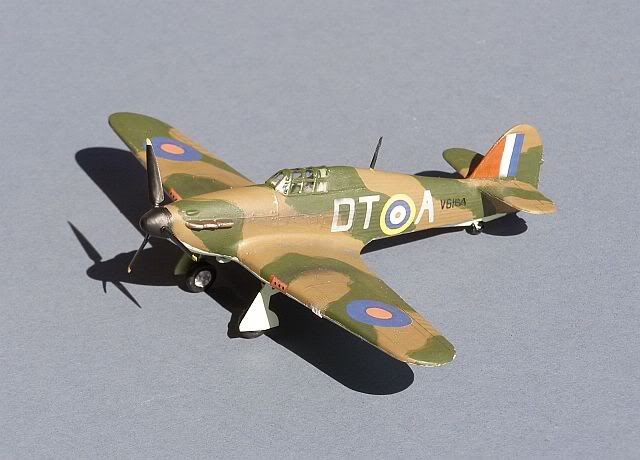
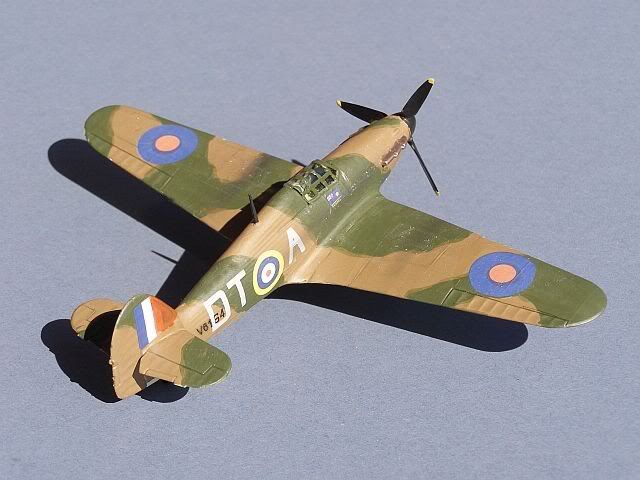
The Airfix Mk I Hurricane is a straightforward, but reasonably accurate kit, which I have used as the basis for several of my Sea Hurricanes. Whatever you do, though, don't confuse it with the strangely shaped, newer and more expensive Mk II/IV kit, which is NOT GOOD. For this one, I have taken the kit markings, which represent the aircraft as photographed above in November 1940, and modified them to reflect the key BoB period (no sky fighter band on the fuselage, and no black wing).
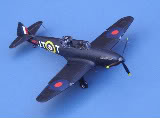
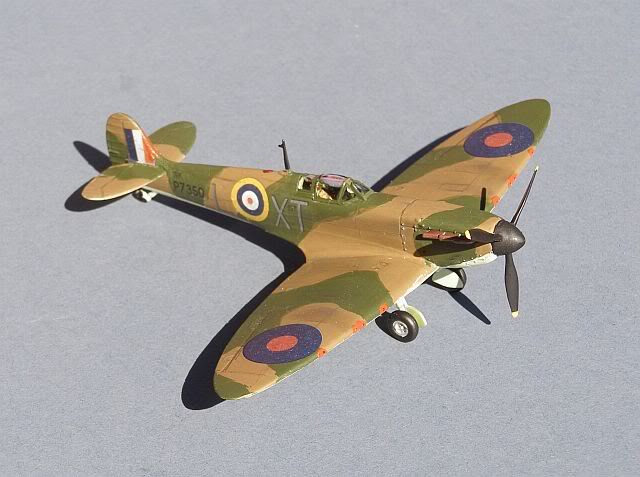
Supermarine Spitfire Mk.IIa - 603 (City of Edinburgh) Royal AuxAF Squadron,
RAF Hornchurch, Battle of Britain, September 1940
Airfix 1/72 - "Gin ye daur - (Scots: 'If you dare')
|
|
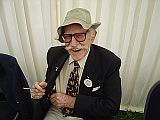
603 Sqn has the distinction of shooting down the first German aircraft to be shot down over UK since 1918. - a Ju88 over Dalkeith, on 16 Oct 1939. For the first period of the Battle of Britain, 603 Sqn remained in Scotland, but on 27 August 1940, they were deployed south to 11 Group and RAF Hornchurch. This was during the critical phase of the battle, when RAF airfields were being attacked. Spitfire Mk.II P7350 is both the oldest Spitfire still in flying condition and the last surviving aircraft from the Battle of Britain still able to fly. The 14th of 11,939 Spitfires built at Castle Bromwich, she was built in August 1940. In 2007, as part of the RAF Battle of Britain Memorial Flight, she was repainted in the 603 Squadron letters XT-L, those of Gerald 'Stapme' Stapleton's personal aircraft. "Stapme" Stapleton DFC, DFC (Netherlands) was one of the key pilots of 603 Sqn. He was also one of the small group of RAF volunteers who flew Hurricat aircraft from merchant ships during the Battle of the Atlantic. In December 1944, whilst flying a Typhoon on ground attack missions, Stapleton was forced down and captured, remaining as a PoW until May 1945. |
The Mk IIa Spitfire introduced the constant Speed Rotol propellor (Rotol was a joint venture between engine manufacturers ROlls Royce and BrisTOL to produce advanced propellor designs) and the more powerful RR Merlin XII engine. Many consider it to have been the best engineered and balanced Spitfire mark.
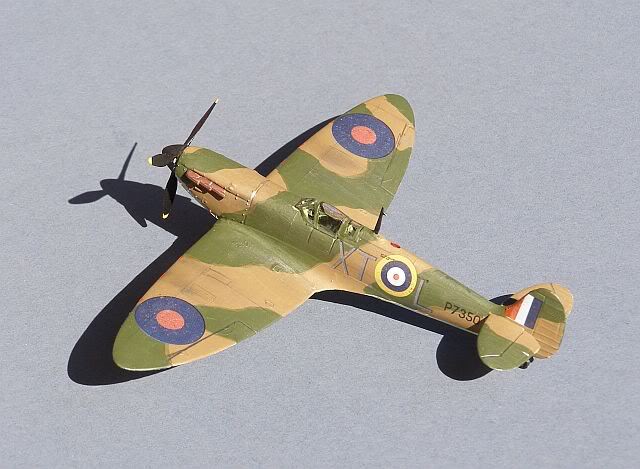
The 1974 Airfix Spitfire remains one of the best representations of this iconic aircraft. A simple build, with absolutely no vices, this one was a prize given to my daughter at a model competition; as her entry had been an Airfix Mk Ia Spitfire (itself a prize from the previous year), she didn't want another one, so rapidly sold the kit on to her poor old dad! The markings represent the aircraft as painted for the Battle of Britain Memorial Flight in 2007.
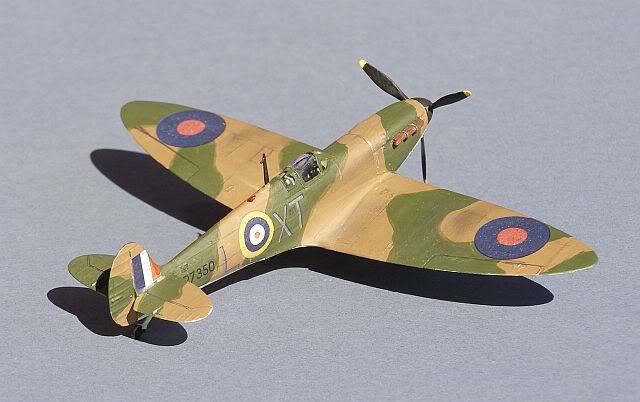
Remarkably, for someone who has been building model aircraft for more than 40 years, this is actually my first ever Spitfire build (although I have certainly turned plenty of Spitfire kits into Seafires!).
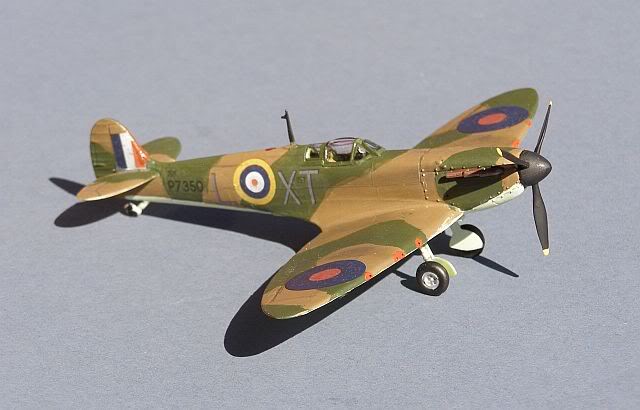
To the men (and women) of the Royal Air Force, Fleet Air Arm, Commonwealth and Allied Forces, who fought so hard for our freedom in 1940 - thank you.
Other Battle of Britain-era aircraft on my website (click on the thumbnails to learn more):
|
Gloster Gladiator: |
|
|
Bolton Paul Defiant: |
|
|
Blackburn Skua: |
|
|
Blackburn Roc: |
|
|
Fairey Fulmar: |
|
Link to more RAF Aircraft on my Friends & Allies Pages
Link to more WW2 Royal Navy Aircraft on my RN Props pages
Links
to related pages on this Website:
www.gengriz.co.uk